Tuesday

fullfilling days

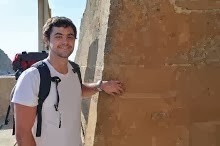
As I sit here in a sleeper train compartment accompanied by at least 4 cockroaches, 2 jet-lagged unconscious Japanese tourists and a nomadic, bisexual ex-male prostitute, I think it’s time to reflect on the happenings of the past several days. I haven’t been blogging due to school’s momentary interference with my education, but thankfully yet another paper in my tedious academic career is now behind me. My first full day in Cairo was the 22nd, and I was greeted bright and early by my 3 adoptive mothers and their hired driver, Ahmed. The pyramids occupied the forefront of my mental and geographic horizon as we sped, swerved and scampered along the chaotic highways to Giza. Entrance inside the great pyramid of Khufu is limited to the day’s first 300 visitors, and I didn’t travel 1800 miles to be number 301. A satisfactory description of the 3 mammoth structures and their satellites is simply impossible…large, rocky and polygonal doesn’t quite capture it. The entire Giza complex contains roughly 3,000,000 boulders, each weighing between 2.5 and 16.5 tons, each individually quarried and shipped down the Nile, and each meticulously set in place with an elaborate network of sleds and slaves. We were able to get tickets to go inside, and we explored the structure’s innards and saw the tomb so important that it necessitated omni-directional stone insulation 200 feet thick. And while Ben Jones was playing Indiana Jones, Ahmed was negotiating the day’s next activity.

Camels are not actually indigenous to Egypt, as evidenced by their absence in ancient Egyptian art, which frequently depicts other animals. Endearingly awkward and teeming with personality, the beasts of burden were most likely introduced to Egypt by the Persians. Typically I make fun of camel jockeys, but that day I was one. My camel, Michael Jackson, was slightly stubborn and handled like a three-wheeled Hummer with blown struts. We sauntered (at times galloped) Ali-Baba style around the complex and nearby Sphinx over the course of a couple of hours and I became increasingly convinced that my next car should, in fact, be a camel. I’d love to see that DMV registration.

Class: SUV

Year: 2002

Make: Syrian

Model: Twin Hump

Color: Brown

After a lunch of koushary, an Egyptian dish featuring several types of chopped pasta, lentils and chickpeas, we traversed the city’s madness to reach the Citadel of Saladin, a large fortress complex that today houses an enormous, imposing mosque built by Mohammad Ali in the 1850s. The pyramids were originally even more spectacular, coated with a layer of gleaming limestone that shone with prismatic radiance in the sun. Ali, being a douchebag, plundered the stone to build his monument. The mosque’s interior is intricate and opulent, a sort of middle-eastern corollary to St. Peter’s Cathedral in Rome. Its patrons are an interesting bunch, half praying Muslims and half tourists photographing praying Muslims.

The day was grueling, highly exhausting, but one of few I know I’ll never forget.

1/23

I was to meet the mothers and Ahmed at the Egyptian Museum at 9 a.m. sharp. My guidebook advised an early arrival to avoid the afternoon crowds, so I figured an arrival at the museum’s opening time would provide a leisurely perusal of some of the world’s most spectacular artifacts. On that morning, however, Japan invaded Egypt. Dozens of tour buses adorned with Japanese symbols opened their doors as the clock chimed 9 and a sea of diminutive, chattering beings emerged. They say ants can bear up to 10 times their body weight. The Japanese can do the same with Nikons. They’re culturally oblivious to the concept of personal space, and I was so thoroughly groped in the ticket line that buying me dinner beforehand would have been only polite

Once inside, I was simultaneously awed and depressed. Performed by removing all internal organs (heart and kidneys excepted) and bodily moisture, mummification is designed to preserve a corpse as thoroughly as possible. Egyptians believed that keeping the body intact aided in the transition to the new body in the afterlife. The same principle is applicable in Egyptian art; the side-profile was utilized to present the body’s elements in their entirety (especially the eye). Pharaohs and other wealthy denizens had their servants and pets ritually slaughtered upon their death and (along with other riches) buried with them so that they could be served and entertained for eternity. Their culture and religion dictated that life be spent preparing for death, yet who knows if their obsession with the afterlife is at all founded. They were polytheists, heathens by Christian and Islamic standards, so either this entire ancient civilization is rotting in hell (as Christianity teaches Jesus opened the gateway to heaven about 2000 years ago), or modern day theists have the wrong idea about what happens after we inevitably pass away.

The award for most remarkable museum content undoubtedly goes to the burial artifacts of King Tut. He was a little-known, largely unimportant boy-king who died at the age of 18 after a less than 10 year reign. What makes him the face of Egyptian antiquity is the discovery of his burial chamber intact and unspoiled by Howard Carter in 1922. Among the spoils on display are his 25 pound gold burial mask and a sarcophagus adorned with enough bling to make any rap mogul green with envy. The runner-up prize goes to the animal mummy room, which has an impressive collection of preserved cows, baboons, birds, cats and yes, even Nile crocodiles. Animals’ internal organs were not preserved, but liquefied and removed via a turpentine enema shortly after death. Yum.

The Egyptian mom, Sohar, treated us to a lunch with her nieces aboard a Nile riverboat. Eating above my means was the upside of traveling with three older women. Shopping was the invariable downside. They were keen to peruse mass-produced, made-in-China garbage from tourist trap souvenir stores. Egypt T-shirts. Sphinx-themed magnetic tea saucer sets. Scarab paper-weights. Pyramidal jewelry boxes. Stuffed camels with “I Love You” sewn across them. I guess it’s the thought that counts, but why not bring people back something real? If you go to Berlin, for example, get a crumble from the wall. If you go to Zimbabwe, get a tiny denomination of the local currency. Get anything that has or once had relevance in regards to your location. Two hours and 136 “special price my friend”s later, I bid final farewell to my brief companions and concluded the day.

1/24

Alexandria, on Egypt’s northern coast, is positively teeming with history. The ancient library, founded sometime in the first half of the 4th century, contained a wealth of knowledge from all over the known world. All ships entering the port were obligated to surrender any manuscripts on board for copying and cataloguing. Nobody really knows the extent of information contained there, but there have been glimpses that suggest it was highly advanced. The Piri Reis map, for example, was likely conceived using information from the library. The Pharos of Alexandria (better known as the lighthouse) was one of the 7 ancient wonders of the world. It was the world’s tallest structure at the time, and may have housed the world’s first lens, used both to magnify ships in the distance and concentrate sunlight to burn enemy vessels. Unfortunately, both structures were destroyed (the former by fire, the latter by earthquake), but I still wanted to visit Alexandria to imagine and bask in what once was. So I did.

Due to a computer snafu, all my pictures from today were mysteriously deleted. I'm in the process of procuring copies, and I’ll edit them in as soon as I get them.

I met and banded together with a fellow hostel dweller, Hans (German), and we wiled away the 3 hour train ride sharing stories. Reaching our destination (and with no Ahmed to ferry us around), steam locomotion gave way to bipedal. It was an absolute nightmare. Crossing the street is like real-life frogger (see: “If you can dodge traffic, you can dodge a ball”). The highlight of the day (by far) was the modern library that occupies the spot of the original. It takes the form of an enormous disk slanted and wedged into the ground at an angle. An impressive stone relief serving as part of the building’s façade is imprinted with symbols and words from every alphabet in existence. Inside is extensive and immaculate, an absolute contrast to the filth and squalor of the world outside. Was it worth 6 hours in a train to see two buildings that don’t exist anymore? Yep.

Schoolwork is terrible. I stayed up most of the night perfecting and expanding a scientific paper on principal-agent theory in the telecommunications sector. Will this have any use in the future? No. Did I want to write it? Certainly not. Does my professor want to read it? Uh uh. Then why am I writing it? Uh…

1/25

I slept most of the day as a result, but felt like I’d pretty much accomplished Cairo at this point. I (barely) survived the walk to the train station and spent an hour and a half trying to purchase my ticket for the overnight train to Luxor. Hans proposed we watch the big soccer match that evening, Egypt vs. Cameroun in the Africa Cup of Nations tournament, and we trudged around trying to find a venue. Muslims are prohibited from consuming alcohol (which is actually an Arabic word), so bars take the form of coffee shops where the boys get together for a few water pipes and a game of backgammon. Hans and I settled in at one of these cramped and crowded establishments and adhered ourselves to the tiny tube television hanging from the ceiling. The small shop buzzed with energy, and any activity in favor of Egypt was met with fist pumping and enthusiastic Arabic from the hometown crowd. Egypt 3-1, in overtime.

Hans and I parted after the game and, amazingly, I was briefly alone for the first time after 4 days in Cairo. For security reasons, tourists are relegated to one train daily from Cairo to Luxor. In my cabin I encountered Brian. Originally from Salt Lake City, his devout Mormon parents kicked him out of the house when he was 17. He migrated to Los Angeles and began satiating his lust for travel by satiating the lust of others. The petite, effeminate man-slut is now 29, lives in Berlin, uses occasional DJ gigs as his sole source of income, and continues to spend any excess on travel. This guy’s been to more than 60 countries. His knowledge of geography and “the way the world works” is staggering, and his current choice of light reading is a book surveying 20th century world history. He’s what most people would call “cultured," and he got that way by selling himself. It’s an interesting story, to say the least.

Tomorrow I’m headed to the fabled Valley of the Kings, never a dull day in Egypt. Never.

Thursday

cairock and cairolling

What do jamaican phone psychics, Bernie Madoff, confederate plantation owners, and your local mortician have in common? Why, Egypt of course. Miss Cleo(patra), pyramid schemes, slave labor, and body preservation are all inextricably linked to this buried land of sun and sand. Still unbelievably jetlagged from my flight to Copenhagen, I headed back to the airport to tackle my third continent in as many days.

Copenhagen to Frankfurt? Typical. Frankfurt to Cairo? Atypical. I checked my ticket four times to make certain I wasn't on a flight to south Florida. Herds of obese American geriatrics conversed in loud English seasoned with various regional dialects: "Oh Maatha, I love ya new hair, did you daaken it?" I'd take unintelligible German dribble over that any day.

I slept the entirety of the flight, but struck up a conversation with the three middle-aged women seated in my row as the plane touched down. I'm such a charmer, I know. It turns out they all live in Texas, and one of them was an arabic-speaking Egypt native visiting family in Cairo. She was able to write my hostel address in arabic for a cab driver, and offered to let me tag along in their car to go to the pyramids at Giza tomorrow. Mommy always said not to get in cars with strangers, but when they can translate arabic for you (and have a hot niece), exceptions must be made.

My cab ride from the airport was absolutely ridiculous. The entire Egypitan traffic system ignores any sensical rules of the road in favor of gesticulations, honks, and tacit understandings. A three lane highway routinely supports traffic 5 cars abreast, and the number of near-misses we endured during my half-hour tenure is staggering. Collecting fares is apparently a very competitive endeavor here, so cabbies "bling out" their 3-cylinder, $4,000 ultra-compacts with everything from spinning hubcaps to fuzzy dice to neon underglow. Who needs useless frivolities like rear seat belts when you have a DVD player built into the passenger's seat sun visor? I'm totally sold on the concept. From now on, if your taxi doesn't look like it jumped straight out of a Hot Wheels catalogue, I'm not riding in it.

T-minus 7 hours until the pyramids...can you sense my enthusiasm?

Wednesday

For Christmas, my uncle received a .22 rifle to shoot squirrels off of his bird feeder. God bless the U.S.A.

Tuesday

repatriation

My transcontinental flight home for the holidays was littered with epiphanies and observations, some positive some negative.

1. Flying sucks. At best, I felt like a peasant in a tyrannical monarchy. At worst, I felt like a pack animal. Upon check-in, there were two lines. Each had equal staffing and equal capacity. But one had 200 people in it, and the other had at most 2. The economy line was atrocious, snaking back and forth across the terminal in a formation that bore explicit resemblence to a cattle run. Dub over the chatter of aggravated passengers with mooing and you'd think you were in a slaughterhouse. There was even an attendent herding passengers in an effort to keep the vacant line for Priority Plus and Business class unobscured. I honestly wondered if she was going to require us peons to bow before the "royalty" strolling up the red carpet to the VIP counter. Let's hear it for socioeconomic stratification.

Even more disheartening is passenger behavior. When the flight attendants roll the service carts up the aisle, everybody lowers their traytable. I did it myself, and was instantly disgusted. Pavlov taught dogs to salivate at the sound of a bell. Delta taught humans to lower traytables at the sight of a food vessel. What's the difference?

2. I live a long, long way from home. Somehow, my transatlanticism had never really sunk in. I stared at my customs form and read "Country of Residence:" I hesitated and finally wrote "Denmark." I have no clue why, but it took that fact a solid few seconds to register.

Being back in the States is proving to be a great time. I've eaten the hell out of some food at every Mexican restaurant in the greater Chapel Hill area, rekindled my romantic flair with sweet tea, and caught a couple UNC games. There's been a recent dearth of blog-worthy material, but hopefully that changes soon. Until then...

Sunday

snowpenhagen

Congratulations, climate demonstrators, your effort to stave off global warming appears to be remarkably successful. Either that, or Mother Nature smote you with a blanket of the powdery white stuff. Though highly unusual for December, snow is in the forecast for 7 of the next 10 days. And the city is already laden with grotesque, infinitely refrozen sludge patches and other vestiges of last week's accumulation.
Thirty-six percent of Copenhagen's 1.2 million people commute to work by bike, and watching the otherwise immaculate and effortlessly confident Danes totter and tumble in the snow is proving immensely entertaining. Slightly less entertaining is the way I've spent the last two weeks...battered and bruised by body blows from business heavyweights Corporate Finance and Financial Markets and Instruments. Since I've been hunkered down in a study bunker most of the month, not a whole lot has happened worthy of mention. Jeppe's exasperated expression pretty much encapsulates December:

Friday

fmi? fml.

Oh Financial Markets and Instruments, your unceasing, unyielding barrage of betas, covariances, correlations and matrices was a source of perplexity and agony over the last 12 weeks. You could safely assert that my happiness and the end of this god-forsaken class have a correlation of 1. Coming into today's exam, I felt like Rocky running up the steps of the Philadelphia museum of art, shadowboxing my numerical foes to the tune of Eye of the Tiger. I received my test paper and feverishly leafed through the pages. Then this happened:

Question 6 (weight 20%)

You have estimated the Single Index model for two oil companies, Exxon Mobil Corp. (XOM) and Chevron Corp. (CVX), using monthly data of excess returns over the past five years. You have obtained the following results:

R(cvx) = .72% + .56R(m)+e(cvx) R^2(cvx) = .19
R(xom) = .58% + .57R(m) + e(xom) R^2(xom) = .22

The standard deviation of monthly excess market returns is estimated at 4.5%. Recall that the Single Index model assumes that Cov(e(cvx),e(xom)) = 0.

1. What are the standard deviations of the monthly excess returns of CVX and XOM?
2. In the Single Index model, how much of the variance in CVX is due to its systematic component, and how much is due to its firm-specific component?
3. Find the correlation between the excess returns of CVX and XOM implied by the Single Index model
4. You have also directly estimated the correlation coefficient between the excess returns of CVX and XOM to be .78. Briefly explain in words what might account for the difference between the .78 and your answer in 3, and briefly describe how you might improve on the Single Index model to obtain a more precise correlation estimate between the two stocks.

Now, I had put more than 40 hours into studying for this 4-hour exam, and felt my knowledge of the subject matter unequivocally thorough. That having been said, here's an excerpt from my internal monologue upon reading this question:

Is this &*å@ in Danish or what? @$#*. Ok, let's analyze this. The ankle bone's connected to the...thigh bone. No wait, wrong subject. And that's not even correct! Thank God you didn't go into medicine. Although that's an interesting evolutionary proposition. What would people look like if ankles connected to thighs? Squat, undoubtedly, and no way our savanna-dwelling ancestors could have outrun cheetahs and other exotic creatures to survive and reproduce. Great job, Ben, your anatomical supposition would have led to the extinction of mankind. Ok, right, exam, focus...you're being retarded. Well, retarded actually wouldn't be all that bad...Rain Man could probably figure out this crap. And he could just go to Vegas and make a fortune anyways, no need for advanced financial degrees. Just Vegas, fish sticks, and K-mart underwear. No need to deviate from that. Deviate. Standard deviations of the monthly excess returns...you need the derivation of the R^2 formula to solve for that. R-squared. Finance is truly for squares. Heh, that's a pretty good one. Blanking on the formula derivation, so blanking it is.

I walked to the front of the class and joined about 65 other students in turning our papers in blank and leaving. Eye of the Tiger was replaced with a morose violin concerto. Denmark's re-exam system allows students who failed (or turned in blank) exams to try them again 2 months later, and I opted to take that route. I estimate I would have gotten a grade of 7 (average) had I completed the test, but I'm average in too many other respects (see: height, weight, hair color, eye color, etc.) to settle for average grades.

We shall meet again in February FM&I, and next time you won't be so fortunate.

Wednesday

can we kiwi?

Study abroad applications were due yesterday for the fall 2010 semester, and everybody I know from my program (and my roommate as well) planned to submit one. My choices were to either remain at CBS, further embedding myself in Danish culture, mastering the language, and boosting my GPA through hard work and dedication OR abdicate both the country and all scholarly responsibilities in the name of excitement, frivolity, and a pass/fail grading system.

New Zealand, I'm on my way.
There's something slightly amusing about being an American studying abroad from your overseas home university. There's something even more amusing about going back to UNC as a graduate exchange student, which I attempted. But, in a sizzlingly ironic twist, I didn't have the undergraduate grades to qualify.

I selected the University of Otago, on New Zealand's south island, as my preferred destination. Why this particular institution? Allow me to bestow a few nuggets upon you:
"Couch burning is a frequent, illegal problem with partying students in the student neighbourhood surrounding the campus. In 2007, a pub owner was charged with sedition over a pamphlet offering students the prize of a fuel-soaked couch."

"Large scale clashes between Otago and Canterbury University students and police took place in 2006, 2007, 2008 and 2009 related to events surrounding the Undie 500 car rally organised by students from Canterbury University. Other student social events during the year such as the Toga Parade and the Hyde Street Keg Race are also notable for attracting Police attention, but not to the scale of the Undie conflicts."
Otago is also the country's top-ranked research university and the 2nd best overall. But still, as you can tell from the quotes, the university sounds like a perennial riot. I just wish the campus were more aesthetically pleasing.

The university is in a vibrant college town, Dunedin, of 123,000 people. The cricket grounds are manicured, the music scene is flourishing, and the beaches contain as many penguins as people. The problem is how to get there. Kayak.com currently lists one-way fares at around $1800 (9000 DKK) from Copenhagen to Dunedin, and the shortest flight duration I can find takes 35 hours and over 12,000 miles (19000 km) to reach its destination. Copenhagen has a street called Istedgade I could probably patrol to make some money, but I think my parents, the University of North Carolina, and I would all be ashamed that my business degree led to the purchase of a leopard-print skirt and some clear high heels.

And here's the final crux in this grandiose globetrotting concoction: When I leave the US on January 18th, I might not be back for 18 months. Due to the reversal of seasons in the southern hemisphere, I'll go straight from spring semester at CBS (ends in June) to spring semester at Otago (starts in July) and attempt to get a "summer" internship in Australia from Nov-Feb before writing my thesis. Still, it's hard to say no to New Zealand...especially when it looks like this: